Making Better Technology Investment Decisions
A Practical Guide for CEOs, Founders, CIOs, CTOs, and Technology Leaders
A successful technology investment strategy begins long before selecting software, evaluating vendors, or approving implementation budgets. Every major technology investment is ultimately a business decision that should support measurable business outcomes rather than technology adoption alone.
Every successful technology investment strategy begins with a business decision rather than a technology decision.
Whether an organization is considering AI, cloud, custom software, legacy modernization, or enterprise platforms, the technology itself rarely determines success. The outcomes are shaped by the decisions made before implementation begins.
Many organizations invest significant time evaluating products, vendors, and technical features, yet spend far less effort defining the business capability they want to create, the value they expect to deliver, or the governance required to achieve it. As a result, projects that are delivered successfully can still fail to generate meaningful business outcomes.
This Executive Playbook presents a business-first approach to technology investment decisions. Rather than focusing on products or implementation methodologies, it introduces six executive decisions that help leaders evaluate investments before significant budgets are committed. These decisions cover business outcomes, investment strategy, operating model, solution approach, governance, success measurement, and long-term value realization.
Designed for CEOs, founders, CIOs, CTOs, and technology leaders, this playbook provides practical guidance to reduce risk, improve decision quality, and ensure that technology investments remain aligned with business strategy.
Organizations that consistently achieve better outcomes are not those that simply adopt the latest technologies. They are the ones that make disciplined decisions, align investments with strategic objectives, and measure success by business value rather than project completion.
That is the purpose of this Executive Playbook.
In this Executive Playbook, you’ll learn how to:
- Define business outcomes before selecting technology.
- Evaluate the right investment approach for long-term value.
- Reduce investment risk through better executive decision-making.
- Measure success using business outcomes rather than project completion.
- Maximize long-term value from technology investments.
01. Every Technology Investment Is a Business Decision
For many years, technology was viewed primarily as a support function. Business leaders defined strategy, operations executed it, and technology enabled the business behind the scenes. Major technology decisions were often delegated to IT teams because they were considered technical in nature.
That model no longer reflects today’s business reality.
Technology now influences how organizations compete, how customers experience products and services, how employees work, how decisions are made, and how businesses respond to changing market conditions. Whether an organization is investing in artificial intelligence, cloud platforms, enterprise applications, data analytics, cybersecurity, or custom software, the decision extends far beyond selecting a technology solution. It shapes business capabilities, operating models, customer experience, and long-term competitiveness.
This shift has changed the role of executive leadership.
Technology investments now compete directly with other strategic uses of capital, including market expansion, acquisitions, product innovation, talent development, and operational improvement. Every major investment requires leaders to balance opportunity, risk, cost, and expected business value. These are executive responsibilities, not technology responsibilities.
As a result, successful organizations involve business and technology leaders from the beginning of the decision-making process. Technology teams contribute technical expertise, but executive leadership defines the business outcomes, investment priorities, and measures of success. This shared ownership improves alignment, reduces unnecessary risk, and increases the likelihood that technology investments deliver measurable business value.
The organizations that consistently realize the greatest return from technology are not those that simply adopt new tools more quickly. They are the ones that make disciplined investment decisions, align technology with business strategy, and treat every major initiative as a business transformation rather than an IT project.
This change in perspective leads to an important question.
If technology is no longer the investment, what exactly is an organization investing in?
The answer forms the foundation of this playbook. An effective technology investment strategy provides a structured approach for evaluating investments before significant resources are committed.
02. The Technology Investment Lifecycle
Every successful technology investment follows a series of business decisions long before implementation begins.
Yet many organizations unintentionally reverse this sequence. Conversations often start with selecting a technology, comparing vendors, or discussing implementation timelines before there is a clear understanding of the business problem, the capability that needs to be created, or the value the organization expects to realize.
This approach increases uncertainty, introduces unnecessary risk, and often results in solutions that are technically successful but commercially disappointing.
High-performing organizations take a different approach.
They recognize that technology is only one stage in a much broader investment journey. Each decision builds upon the previous one, helping leadership reduce uncertainty, align stakeholders, and ensure that every investment supports a measurable business objective.
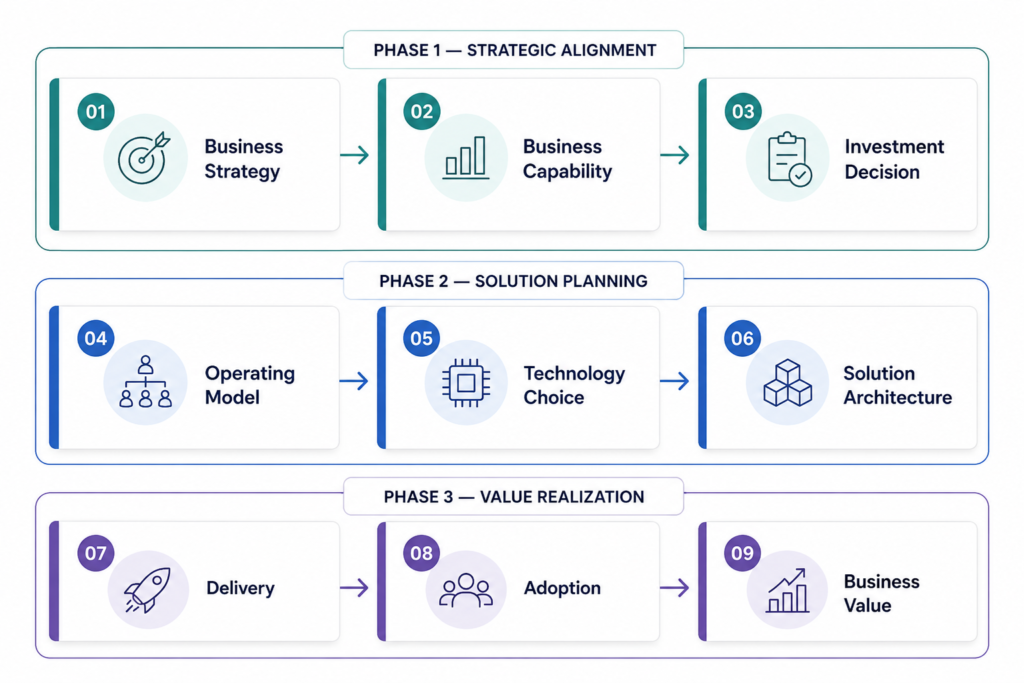
The lifecycle begins with Business Strategy, where leadership defines the organization’s strategic priorities. These priorities determine the Business Capabilities the organization must strengthen to achieve its objectives. Once those capabilities are clearly understood, executives can make informed Investment Decisions by evaluating business value, opportunity cost, and alternative approaches.
Before selecting technology, organizations should establish an Operating Model that defines how people, processes, governance, and responsibilities will work together. Only then should they evaluate the most appropriate Technology Choice and design a Solution Architecture capable of supporting long-term business needs.
The focus then shifts to Delivery, where disciplined execution transforms strategy into working solutions, followed by Adoption, where change management, training, and operational readiness ensure that the investment is embraced across the organization.
The final destination is not project completion but Business Value. Success should be measured by tangible business outcomes such as increased revenue, improved customer experience, operational efficiency, reduced risk, or stronger competitive advantage.
One important observation emerges from this lifecycle.
Most organizations begin their conversations at Technology Choice.
Successful organizations begin at Business Strategy.
That single shift changes the quality of every decision that follows.
Throughout this Executive Playbook, each of the six executive decisions builds upon this lifecycle, providing practical guidance for moving from strategic intent to measurable business value with greater confidence and lower risk.
03. Technology Is Not the Investment
Every significant technology initiative begins with a decision.
The question is whether that decision starts with the business or with the technology.
In many organizations, conversations begin with proposed solutions.
“We need a new CRM.”
“We should move to the cloud.”
“We need an AI strategy.”
“Our ERP needs to be replaced.”
These statements may sound reasonable, but they skip the most important question:
What business problem are we trying to solve?
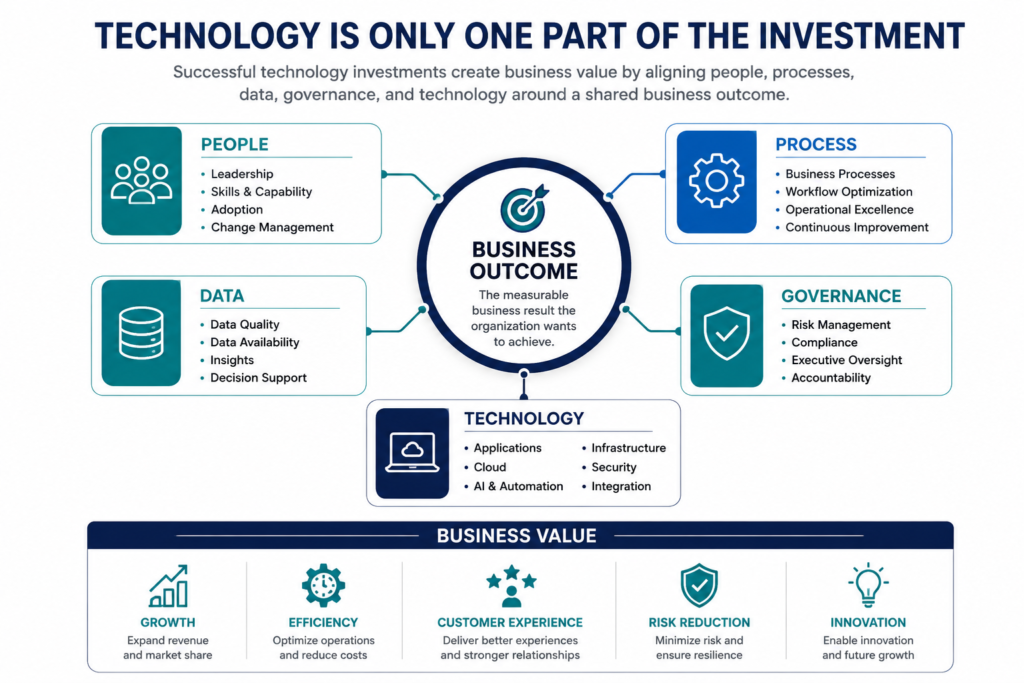
Technology is rarely the objective. It is one of many possible ways to achieve a business objective. When organizations begin with technology instead of business needs, they risk investing in solutions that address symptoms rather than underlying challenges.
High-performing organizations reverse this sequence.
They begin by defining the business problem, identifying the capability that needs to improve, and evaluating whether technology is the most appropriate way to achieve the desired outcome.
This approach produces better investment decisions because it focuses on business value before technology selection.
Business Capability Is the Real Investment
Organizations do not invest in software simply to own better technology.
They invest to strengthen capabilities that help the business perform better.
A customer relationship management platform is not the investment.
The investment is building stronger customer relationships, improving sales effectiveness, and increasing customer retention.
An enterprise resource planning system is not the investment.
The investment is creating more efficient, standardized, and scalable business operations.
Artificial intelligence is not the investment.
The investment is enabling faster decisions, automating repetitive work, improving customer experiences, or creating new business opportunities.
Cloud migration is not the investment.
The investment is improving business agility, operational resilience, scalability, and the ability to respond more quickly to changing market demands.
Technology enables these capabilities.
It is not the capability itself.
This distinction changes how executive teams evaluate opportunities, prioritize investments, and measure success.
Technology Is Only One Possible Solution
Once the desired business capability is clearly defined, leadership can evaluate the most appropriate approach.
Technology may be the answer.
But it is not always the first answer.
In many situations, the real constraint lies elsewhere.
An organization may believe it needs an AI platform to improve customer service, when the underlying problem is fragmented knowledge, inconsistent processes, or poor-quality data.
A company may conclude that it needs to replace its ERP system, when a targeted modernization of critical workflows could deliver the required business outcome with significantly lower cost and risk.
A sales team may request a new CRM platform, when the real issue is an inconsistent sales process or poor adoption of existing tools.
Technology should therefore be evaluated alongside other improvement options, including:
- Process redesign
- Governance improvements
- Data quality initiatives
- Workforce capability and training
- Organizational change
- Technology investment
The best solution is the one that delivers the required business capability with the greatest long-term value and the lowest practical risk.
04. The Six Decisions That Determine the Success or Failure of Every Technology Investment
The success of a technology investment is rarely determined by the sophistication of the technology itself. In most cases, it is determined by a series of executive decisions made before implementation begins.
Organizations often invest significant time evaluating vendors, comparing features, negotiating contracts, and selecting implementation partners. While these activities are important, they are only part of the investment process. The quality of the decisions that precede them has a far greater influence on whether an initiative delivers meaningful business value.
Across industries, successful organizations consistently demonstrate a common pattern. They ask better questions before committing significant resources. They challenge assumptions, evaluate alternatives, and ensure that technology decisions remain aligned with business strategy rather than being driven by urgency, trends, or vendor recommendations.
Poor outcomes rarely result from a single mistake. More often, they emerge from a sequence of decisions that individually appear reasonable but collectively create unnecessary complexity, increased risk, delayed benefits, or reduced business value.
The six decisions presented in this playbook provide a practical framework for evaluating every significant technology investment. They are not intended to replace existing governance processes or project methodologies. Instead, they help executive teams strengthen the quality of the decisions that shape those processes.
Each decision builds upon the previous one. Skipping a step may save time in the short term, but it often transfers uncertainty into later stages where corrections become more expensive, disruptive, and difficult to implement.
Whether an organization is investing in artificial intelligence, cloud platforms, enterprise applications, digital transformation, or custom software, these six decisions provide a structured way to reduce uncertainty, improve alignment, and increase the likelihood of achieving measurable business outcomes.
The decisions are presented in the order they should be considered.
Making them well is often the difference between implementing technology and creating lasting business value.
How to Use This Framework
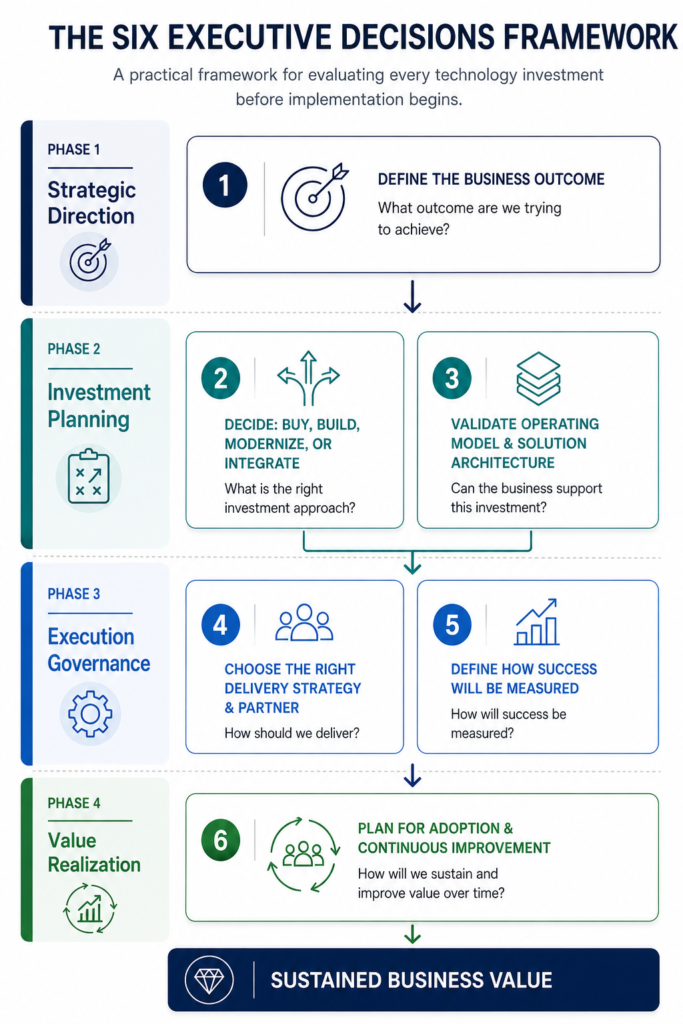
The Six Executive Decisions Framework is designed to help executive teams evaluate technology investments before significant budgets are committed. Rather than focusing first on technology, vendors, or implementation, the framework guides leaders through the critical business decisions that determine whether an investment is likely to deliver lasting value.
Each decision addresses a different aspect of the investment journey. Together, they provide a structured approach for reducing uncertainty, aligning technology with business strategy, and improving the quality of executive decision-making.
The decisions are intentionally presented in sequence. Each one builds on the previous decision, creating a logical path from defining the business outcome to realizing measurable business value. While organizations may revisit earlier decisions as priorities evolve, skipping a step often leaves important questions unanswered and increases the likelihood of costly changes later.
This framework is not a project methodology or a governance process. It is an executive decision guide that complements existing delivery practices by helping leadership teams ask the right questions before implementation begins.
As you work through the following six decisions, consider them as a practical checklist for every significant technology investment. Whether you are evaluating an AI initiative, modernizing a legacy platform, migrating to the cloud, or developing custom software, these decisions provide a consistent way to improve investment confidence and increase the likelihood of achieving meaningful business outcomes.
The first decision is the most important because it establishes the foundation for every decision that follows.
Executive Insight
The quality of a technology investment is determined long before implementation begins. It starts with the quality of the decisions made by executive leadership.
05. Decision 1: Define the Business Outcome
Every successful technology investment begins with a clearly defined business outcome. If leadership cannot clearly articulate the outcome they want to achieve, the organization is not yet ready to make a technology investment decision.
Why This Decision Matters
Many technology initiatives begin with a proposed solution.
“We need a new CRM.”
“We should migrate to the cloud.”
“We need an AI-powered chatbot.”
While these statements describe a possible direction, they rarely explain why the investment is needed or what business value it is expected to create.
Successful organizations take a different approach. They begin by defining the business outcome before discussing technology. They identify the problem they are trying to solve, the capability they want to improve, and the measurable impact they expect the investment to deliver.
This shift fundamentally changes the quality of executive decision-making.
Instead of debating software features, implementation timelines, or vendor comparisons, leadership focuses on the questions that matter most.
What business objective are we trying to achieve?
What measurable improvement are we expecting?
How will customers, employees, or operations benefit?
Technology becomes the means to achieve the outcome rather than the objective itself.
When business outcomes are clearly defined, it becomes easier to evaluate alternative approaches, prioritize investments, align stakeholders, and measure success after implementation.
Without that clarity, even well-executed projects can deliver solutions that meet technical requirements but fail to create meaningful business value.
Common Executive Mistakes
Starting with the Solution
Approving a technology initiative before clearly defining the business problem often results in investing in capabilities the organization does not actually need.
Confusing Deliverables with Outcomes
Launching a new application or implementing a platform is a project milestone.
Improving customer retention, reducing operational costs, or increasing revenue is a business outcome.
Executives should measure the latter.
Defining Success Too Late
Many organizations establish success criteria after implementation has already begun.
Business outcomes should be agreed upon before investment decisions are made.
Trying to Solve Multiple Problems at Once
Technology investments that attempt to solve every business challenge usually become overly complex, expensive, and difficult to deliver.
Clearly defined priorities lead to better decisions.
How to Make This Decision
Leadership teams should agree on four fundamental questions before approving any significant technology investment.
1. What business problem are we trying to solve?
Describe the problem using business language rather than technical terminology.
2. What outcome do we expect?
Define the measurable improvement the organization wants to achieve.
Examples include:
- Reduce customer onboarding time.
- Increase online sales conversion.
- Improve inventory accuracy.
- Reduce operational costs.
- Improve employee productivity.
3. How will we measure success?
Agree on the business metrics that will demonstrate whether the investment has achieved its objective.
Success measures should be specific, measurable, and aligned with strategic priorities.
4. What happens if we do nothing?
Understanding the cost of inaction helps leadership determine whether immediate investment is justified or whether other priorities should take precedence.
Executive Questions
Before approving any technology investment, ask:
- What specific business outcome are we trying to achieve?
- Why is this outcome strategically important now?
- How will customers, employees, or the business benefit?
- How will we measure success?
- What are the consequences of delaying this investment?
If these questions cannot be answered confidently, the organization should revisit the business case before making a technology decision.
Executive Scenario
A retail organization proposes investing in a new customer relationship management platform because sales teams report that the existing system is outdated.
During executive workshops, leadership discovers that the primary issue is not the software itself but inconsistent sales processes and incomplete customer data.
Instead of immediately replacing the platform, the organization first standardizes sales processes, improves data quality, and redesigns customer workflows. Once these business improvements are in place, it becomes clear that targeted enhancements to the existing CRM provide the required capability without the cost and disruption of a full replacement.
The business outcome—improved sales effectiveness and higher customer retention—is achieved through better executive decision-making rather than a larger technology investment.
Key Takeaway
Technology should never define the objective.
The objective should define the technology.
Organizations that consistently achieve better outcomes begin every investment by clearly defining the business outcome they want to create. Once that outcome is understood, every subsequent decision—from investment strategy to technology selection and delivery—becomes clearer, more focused, and easier to measure.
06. Decision 2: Evaluate the Right Investment Approach
Decision Statement
A successful technology investment strategy requires selecting the investment approach that delivers the greatest long-term business value. The objective is not to choose the newest technology or the most popular solution, but to select the approach that delivers the required business capability with the greatest long-term business value.
Why This Decision Matters
Technology investments rarely fail because organizations choose the wrong software. More often, they underperform because leadership chooses the wrong investment strategy.
Many organizations immediately compare software vendors or request estimates for custom development without considering whether those are the most appropriate options. This narrows decision-making too early and can result in unnecessary cost, increased complexity, longer delivery timelines, and greater operational risk.
Experienced leadership teams evaluate several investment approaches before making a technology decision.
In some situations, purchasing a proven commercial solution provides the fastest route to business value. In others, custom development is justified because it supports capabilities that differentiate the organization from its competitors. Existing platforms may only require modernization, while integration between current systems can often solve business challenges without replacing technology that continues to perform effectively.
The objective is not to find the perfect technology.
The objective is to identify the investment approach that best balances business value, implementation speed, operational risk, scalability, and long-term sustainability.
This decision establishes the foundation for every activity that follows, including architecture, vendor selection, implementation, and governance.
Common Executive Mistakes
Assuming New Technology Is Always Better
Organizations often replace existing systems before determining whether modernization or integration could achieve the same business outcome with less cost and disruption.
Comparing Products Before Defining the Investment Strategy
Evaluating vendors too early shifts the conversation from business value to product features and pricing.
Leadership should first determine the most appropriate investment approach.
Optimizing for Initial Cost Instead of Long-Term Value
The least expensive implementation is not always the best investment.
Licensing, support, maintenance, scalability, integration, security, and future enhancements all contribute to the total cost of ownership.
Building Solutions That Do Not Create Competitive Advantage
Custom software should support capabilities that differentiate the business.
Commodity capabilities are often better served by mature commercial platforms.
Overlooking Existing Technology Assets
Organizations frequently underestimate the value of systems they already own.
Modernization or integration can often deliver measurable improvements while protecting previous investments.
How to Make This Decision
Before selecting an investment approach, leadership should evaluate five key considerations.
1. Strategic Value
Does this capability create competitive advantage, or is it a standard business function?
Capabilities that differentiate the business may justify custom investment. Standard capabilities often benefit from established commercial solutions.
2. Time to Business Value
How quickly must measurable outcomes be achieved?
Where speed is critical, buying or modernizing an existing solution may provide faster value than building from scratch.
3. Total Cost of Ownership
Evaluate the complete lifecycle cost rather than implementation cost alone.
Consider licensing, maintenance, infrastructure, security, support, upgrades, operational effort, and future enhancements.
4. Business Flexibility
Will the selected approach continue to support future business growth, regulatory change, and evolving customer expectations?
Technology investments should remain valuable beyond today’s requirements.
5. Organizational Readiness
Does the organization have the people, governance, technical capability, and operational maturity required to support the chosen investment approach over the long term?
WHAT IS YOUR PRIMARY BUSINESS PRIORITY?

BUY
- Fast deployment
- Standard processes
- Lower risk

BUILD
- Competitive advantage
- Unique capability
- Greater flexibility

MODERNIZE
- Extend existing
- Legacy platforms
- Lower disruption

INTEGRATE
- Connect systems
- Multiple platforms
- Better data flow

HYBRID
- Balance speed, flexibility & cost
- Mixed requirements
- Best overall balance
Executive Questions
Before approving an investment approach, ask:
- Does this capability differentiate our business or support standard operations?
- Have we evaluated buying, building, modernizing, integrating, and hybrid options objectively?
- Which approach delivers the required business outcome with the lowest practical risk?
- What are the long-term operational and financial implications of each option?
- Will this approach continue to support the business over the next three to five years?
Executive Scenario
A healthcare provider plans to replace its patient management platform because users report performance issues and limited reporting capabilities.
Rather than immediately approving a replacement, the executive team evaluates multiple investment approaches.
The assessment reveals that the core platform remains reliable, but reporting, workflow automation, and system integrations no longer meet operational needs.
Instead of replacing the entire platform, the organization modernizes reporting services, integrates specialist applications through APIs, and automates manual workflows.
The investment delivers measurable improvements in operational efficiency and user satisfaction while reducing implementation time, cost, and organizational disruption.
The business objective is achieved because leadership selected the right investment approach rather than automatically replacing existing technology.
Key Takeaway
Technology selection should be the outcome of strategic evaluation, not the starting point.
Organizations that objectively assess multiple investment approaches before committing resources consistently achieve better business outcomes, lower long-term costs, and more sustainable technology investments.
Executive Insight
The best technology investment is not always the one that introduces new technology. It is the one that delivers the required business capability with the greatest long-term value and the lowest practical risk.
07. Decision 3: Validate Organizational Readiness for Success
Decision Statement
Technology alone does not determine the success of an investment. Organizations achieve better outcomes when they prepare the business, people, processes, governance, and technology environment before implementation begins.
Why This Decision Matters
Even well-planned technology investments can fail to deliver meaningful business value when the organization is not prepared to support them.
Executive teams often devote significant effort to selecting the right technology while giving less attention to the conditions required for successful adoption. As a result, projects may be delivered on time and within budget but still struggle to achieve the expected business outcomes.
Organizational readiness extends far beyond technical preparation.
It includes leadership commitment, clearly defined business processes, capable delivery teams, effective governance, quality data, change readiness, and a technology foundation that can support future growth.
Weakness in any of these areas introduces unnecessary risk. Strong technology cannot compensate for unclear ownership, inconsistent business processes, poor data quality, or limited executive sponsorship.
Successful organizations therefore evaluate readiness before implementation begins. They identify gaps early, address risks proactively, and create an environment where technology investments can deliver measurable and sustainable business value.
Common Executive Mistakes
Assuming Technology Alone Will Drive Change
New systems rarely improve business performance without corresponding changes in people, processes, and governance.
Underestimating Organizational Change
Employees require clear communication, training, and executive support to successfully adopt new ways of working.
Ignoring Data Quality
Technology investments depend on reliable and well-managed data.
Poor-quality data often undermines otherwise successful implementations.
Weak Executive Sponsorship
Without active leadership involvement, priorities shift, decisions slow down, and organizational alignment weakens.
Delaying Governance Decisions
Governance should be established before implementation begins, not after challenges emerge.
How to Make This Decision
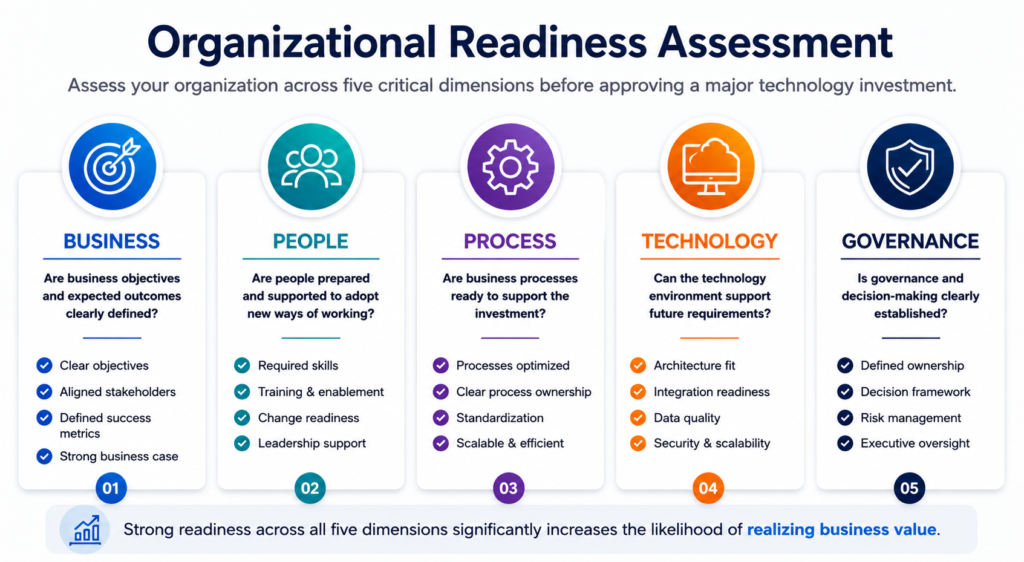
Evaluate readiness across five critical dimensions.
1. Business Readiness
Are business objectives clearly defined?
Have key stakeholders aligned on priorities, expected outcomes, and success measures?
2. People Readiness
Do employees have the skills, training, leadership support, and capacity required to adopt new ways of working?
3. Process Readiness
Have business processes been reviewed and optimized before introducing new technology?
Technology should improve effective processes rather than automate inefficient ones.
4. Technology Readiness
Can the existing technology environment support the investment?
Evaluate architecture, integrations, cybersecurity, infrastructure, scalability, and data quality before implementation begins.
5. Governance Readiness
Are decision-making responsibilities, project governance, risk management, and executive oversight clearly defined?
Strong governance enables faster decisions and reduces implementation risk.
Executive Questions
Before approving implementation, ask:
- Is the organization operationally prepared for this investment?
- Have we addressed the people and process changes required for success?
- Can our current technology environment support future growth?
- Is executive sponsorship active and visible?
- Have governance and accountability been clearly established?
Executive Scenario
A logistics company invests in a modern warehouse management platform to improve operational efficiency.
The implementation is delivered successfully, but productivity improvements remain below expectations.
An executive review identifies the root causes: warehouse processes were inconsistent across locations, employee training was incomplete, and reporting responsibilities were unclear.
Rather than replacing the technology, leadership standardizes operating procedures, strengthens governance, improves training, and establishes clear ownership for operational performance.
Within months, productivity improves, inventory accuracy increases, and the organization realizes the business value originally expected from the investment.
The technology did not change.
The organization’s readiness did.
Key Takeaway
Technology investments succeed when organizations prepare the business as thoroughly as they prepare the technology.
Readiness is not a project activity.
It is an executive responsibility that directly influences investment success.
Executive Insight
Organizations rarely fail because they purchased the wrong technology. They more often fail because they underestimated the organizational changes required to realize its value.
08. Decision 4: Choose the Right Delivery Strategy and Partner
Decision Statement
Selecting the right technology is only part of the investment decision. Organizations must also choose a delivery strategy and implementation partner capable of translating business objectives into measurable outcomes while managing risk, quality, cost, and long-term sustainability.
Why This Decision Matters
A well-defined business outcome, the right investment approach, and strong organizational readiness can still produce disappointing results if execution is poorly managed.
Many organizations focus heavily on selecting technology while treating delivery as a procurement activity. Requests for proposals are issued, vendors are compared, and implementation costs are negotiated. Although these activities are important, they do not guarantee successful delivery.
Successful technology investments require more than technical capability. They depend on choosing a delivery approach that aligns with business priorities, organizational maturity, project complexity, and the level of collaboration required throughout implementation.
The delivery strategy should define how work will be executed, governed, measured, and adapted as business needs evolve. At the same time, the implementation partner should contribute strategic thinking, industry experience, disciplined execution, and proactive risk management rather than simply completing assigned tasks.
Organizations that treat implementation partners as strategic advisors consistently achieve better business outcomes than those that view delivery as a transactional outsourcing exercise.
The goal is not simply to complete the project.
The goal is to deliver measurable business value with predictable outcomes, controlled risk, and sustainable operational success.
Common Executive Mistakes
Selecting Partners Primarily on Cost
The lowest proposal rarely represents the lowest long-term investment.
Delivery quality, governance, experience, and business understanding have a greater influence on project success.
Treating Delivery as a Procurement Exercise
Technology implementation requires continuous collaboration between business leadership, delivery teams, and implementation partners.
A contractual relationship alone rarely produces exceptional outcomes.
Choosing a Delivery Model That Does Not Match Project Complexity
Not every initiative requires the same delivery approach.
Large transformation programs require different governance and delivery practices than focused product enhancements.
Weak Executive Governance
Without active executive oversight, decision-making slows, priorities become unclear, and project risks increase.
Measuring Delivery Instead of Business Value
Completing milestones does not necessarily indicate investment success.
Delivery performance should ultimately be measured by business outcomes.
How to Make This Decision
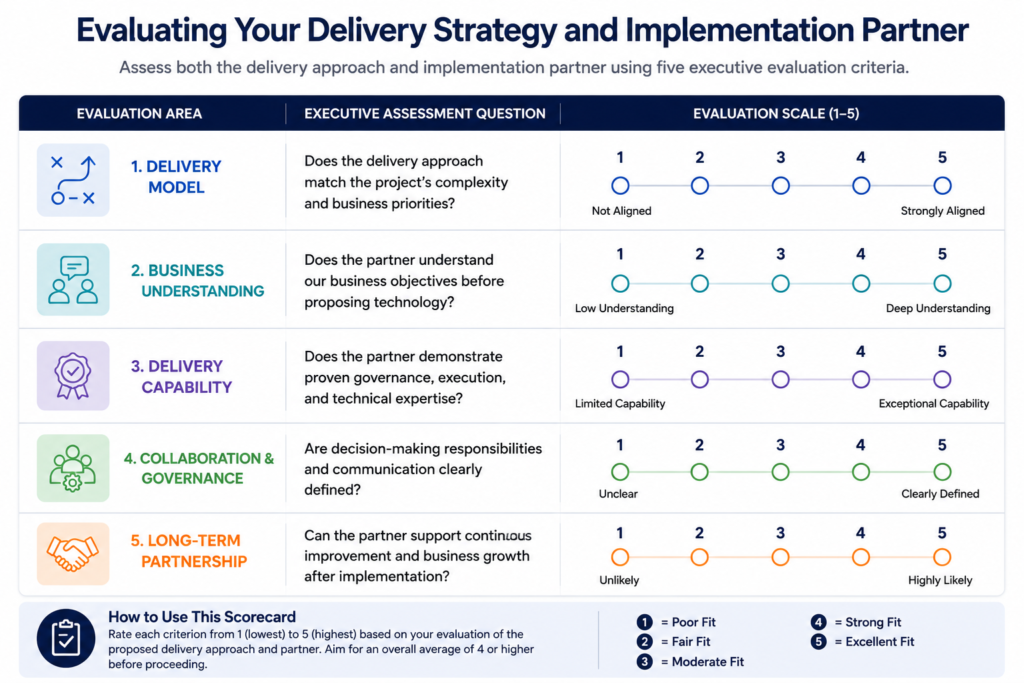
Before selecting a delivery strategy or implementation partner, evaluate five key considerations.
1. Delivery Model
Choose the delivery approach that best supports the project’s complexity, business priorities, and expected pace of change.
2. Business Understanding
Select partners who demonstrate a clear understanding of business objectives before discussing technical implementation.
3. Delivery Capability
Evaluate proven experience, governance practices, technical expertise, quality assurance, communication, and risk management capabilities.
4. Collaboration and Governance
Define decision-making responsibilities, executive sponsorship, reporting structures, escalation paths, and stakeholder engagement before delivery begins.
5. Long-Term Partnership
Consider whether the implementation partner can continue supporting optimization, scaling, and continuous improvement after initial deployment.
Technology investments often extend well beyond project completion.
Executive Questions
Before approving the delivery strategy, ask:
- Does the delivery approach align with our business objectives and project complexity?
- Have we selected a partner based on business value rather than cost alone?
- Is governance clearly established between leadership and the delivery team?
- How will delivery performance be measured throughout the initiative?
- Can the partner continue supporting the business after implementation?
Executive Scenario
A manufacturing company selects the lowest-cost implementation partner for a supply chain modernization initiative.
Although the project begins on schedule, communication gaps, limited governance, and insufficient business understanding result in repeated scope changes, delayed decisions, and increasing operational disruption.
Following an executive review, leadership restructures project governance, establishes joint decision-making, and engages a consulting-led delivery partner with experience in supply chain transformation.
The revised approach improves collaboration, accelerates decision-making, reduces implementation risk, and delivers measurable operational improvements within the planned timeline.
The technology remains the same.
The delivery strategy changes—and so does the outcome.
Key Takeaway
Technology investments succeed through disciplined execution as much as sound strategy.
Selecting the right delivery strategy and implementation partner is not simply a procurement decision. It is a strategic leadership decision that directly influences business outcomes, investment risk, and long-term value realization.
Executive Insight
Organizations rarely outperform the quality of their delivery strategy. The way an investment is executed often determines whether its expected business value is fully realized.
09. Decision 5: Govern Value Realization
Decision Statement
Technology investments do not create business value simply because they are successfully implemented. Executive leadership must actively govern value realization by validating that expected benefits are achieved, sustained, and continuously improved throughout the investment lifecycle.
Why This Decision Matters
Many organizations declare success on the day a technology solution goes live.
The project has been delivered. The budget has been managed. Users have access to the new system.
From a project perspective, implementation is complete.
From a business perspective, however, the investment has only reached the starting line.
Business value is realized only when technology changes the way the organization operates, improves measurable outcomes, and contributes to strategic objectives.
Unfortunately, this is where many organizations lose momentum.
Executive attention shifts to the next initiative, governance activities are reduced, and expected benefits are assumed rather than verified. As a result, user adoption slows, business processes remain unchanged, operational improvements fail to materialize, and the return on investment falls short of expectations.
Organizations that consistently achieve better outcomes treat value realization as an executive responsibility rather than a project milestone.
They establish clear ownership for business benefits, monitor progress against expected outcomes, review investment performance at regular intervals, and take corrective action whenever value is not being realized as planned.
Technology implementation completes a project.
Executive governance completes the investment.
Common Executive Mistakes
Assuming Go-Live Equals Success
Successful deployment is an important milestone, but it does not confirm that the investment has delivered business value.
Treating Benefits as Self-Executing
Business benefits require active leadership, operational change, and continuous monitoring.
They rarely occur automatically.
Losing Executive Focus After Implementation
When executive sponsorship declines after deployment, organizational adoption and continuous improvement often decline as well.
Measuring Activities Instead of Outcomes
Tracking completed tasks, training sessions, or feature releases provides useful operational information, but it does not demonstrate whether the investment has achieved its intended business objectives.
Failing to Act on Performance Gaps
Organizations often identify underperformance without assigning ownership or implementing corrective actions.
Value realization requires both measurement and action.
How to Govern Value Realization
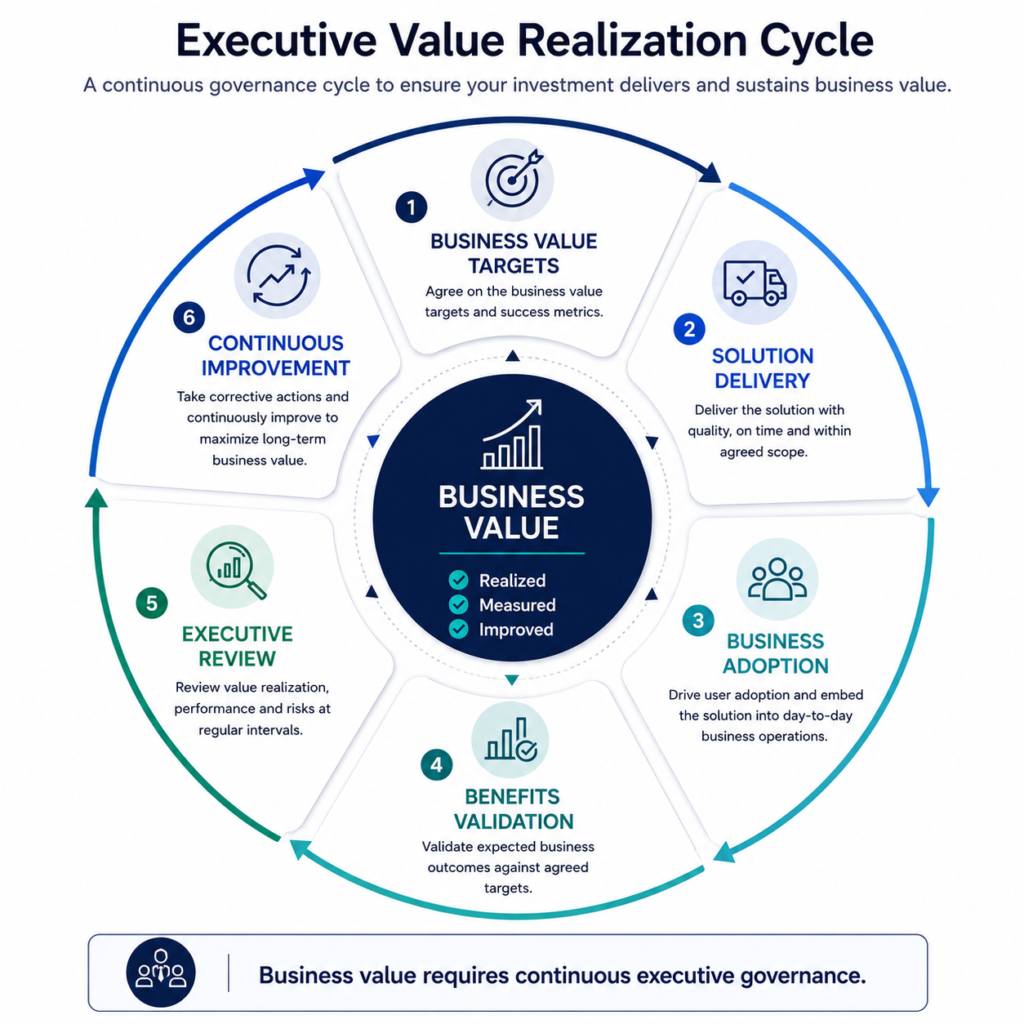
Executive teams should establish a structured governance approach built around five key practices.
1. Assign Executive Ownership
Every expected business outcome should have a clearly identified executive sponsor who is accountable for realizing the intended value.
2. Validate Business Outcomes
Review whether the investment is delivering the business improvements defined in Decision 1 rather than simply confirming project completion.
3. Review Investment Performance Regularly
Schedule executive reviews at agreed intervals after implementation to evaluate adoption, operational performance, financial benefits, and strategic impact.
4. Address Gaps Quickly
If expected value is not being achieved, identify the root causes and implement corrective actions before performance issues become permanent.
5. Drive Continuous Improvement
Technology investments should evolve with changing business priorities.
Use performance insights to optimize processes, improve adoption, and extend business value over time.
Executive Questions
Before declaring an investment successful, ask:
- Have the expected business outcomes been achieved?
- Who is accountable for realizing and sustaining business value?
- Are employees consistently adopting the new ways of working?
- What measurable business improvements have been achieved since implementation?
- What actions are required to increase value over the next twelve months?
Executive Scenario
A financial services company successfully implements a new customer service platform across multiple business units.
Project reporting confirms that implementation is complete, all planned functionality has been delivered, and the initiative remains within budget.
Three months later, an executive value review reveals that customer response times have improved only marginally because support teams continue to follow legacy operating procedures.
Rather than closing the initiative, leadership assigns executive ownership for business value realization, standardizes service processes, introduces adoption targets, and reviews operational performance every quarter.
Within six months, customer response times improve significantly, service costs decline, and customer satisfaction increases.
The project finished at go-live.
The investment succeeded because executive leadership continued governing value realization.
Key Takeaway
Technology projects deliver solutions.
Executive leadership delivers business value.
Organizations that actively govern value realization after implementation consistently achieve stronger returns, greater organizational adoption, and more sustainable business outcomes than those that consider deployment the finish line.
Executive Insight
Technology creates potential. Executive leadership transforms that potential into measurable business value.
10. Decision 6: Sustain and Expand Business Value
Decision Statement
Technology investments should not be viewed as one-time projects. They should be managed as long-term business capabilities that evolve with changing customer needs, business priorities, and market conditions.
Why This Decision Matters
Many organizations successfully implement new technology, realize initial business improvements, and then gradually reduce executive attention.
Over time, user adoption plateaus, business processes evolve, new requirements emerge, and the technology that once created competitive advantage becomes increasingly misaligned with organizational needs.
This decline rarely occurs because the technology is inadequate.
It occurs because the investment is no longer actively managed as a strategic business capability.
Organizations that consistently achieve greater returns recognize that implementation represents the beginning of continuous value creation rather than the end of the investment lifecycle.
They regularly evaluate business performance, identify new opportunities for improvement, incorporate user feedback, modernize capabilities, strengthen governance, and adapt technology to changing business objectives.
By continuously optimizing technology investments, executive teams protect previous investments while increasing organizational agility, resilience, and competitive advantage.
The objective is not simply to maintain technology.
The objective is to continuously increase the business value it creates.
Common Executive Mistakes
Treating Go-Live as the Finish Line
Business value continues to evolve long after implementation.
Delaying Continuous Improvement
Small improvements made consistently often deliver greater long-term value than large transformation initiatives undertaken years later.
Ignoring User Feedback
Employees and customers frequently identify opportunities that leadership cannot observe through reports alone.
Failing to Reassess Business Priorities
Technology investments should evolve as business strategy changes.
Measuring Historical Performance Only
Organizations should evaluate both current performance and future opportunities for value creation.
How to Sustain and Expand Business Value
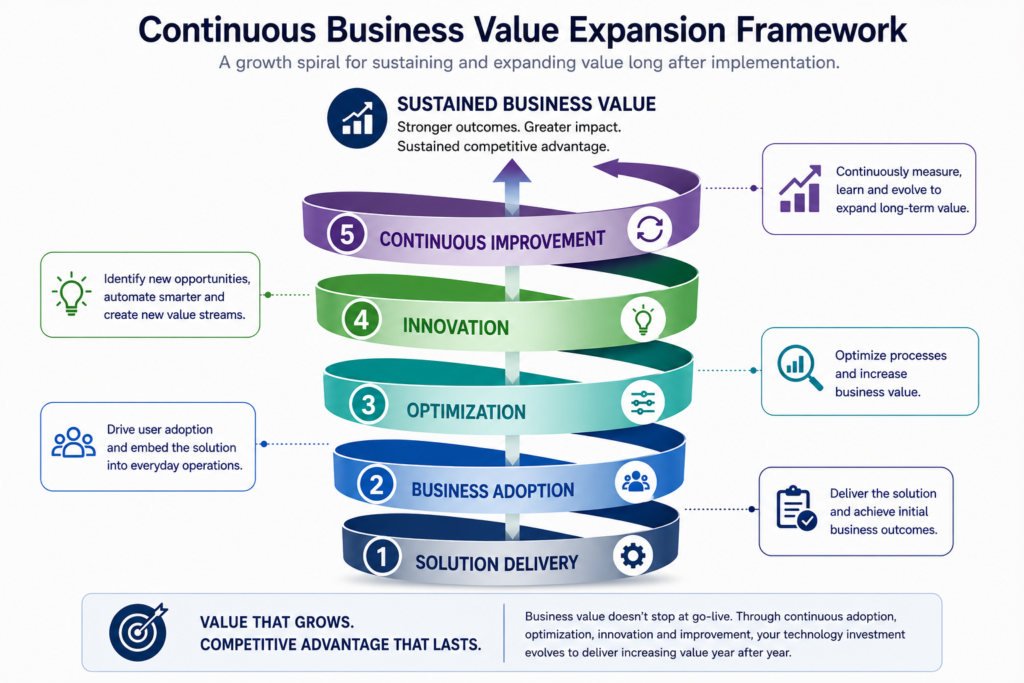
Executive leadership should establish a continuous improvement strategy built around five practices.
1. Review Business Outcomes Regularly
Evaluate whether the investment continues to support strategic objectives.
2. Encourage Continuous Innovation
Identify opportunities to improve processes, customer experience, automation, and decision-making.
3. Modernize Proactively
Refresh technology capabilities before technical debt limits future growth.
4. Listen to Users
Incorporate feedback from employees, customers, and business stakeholders into future enhancements.
5. Align Technology with Business Strategy
Reassess investments whenever organizational priorities, market conditions, or customer expectations change.
Executive Questions
Before closing the investment, ask:
- How will this investment continue creating value over the next three to five years?
- What governance process supports continuous improvement?
- How will user feedback influence future enhancements?
- When will the investment be reassessed against business strategy?
- What opportunities exist to expand business value beyond the original objectives?
Executive Scenario
A retail organization deploys an AI-powered customer service platform that initially reduces response times and improves customer satisfaction.
Rather than considering the initiative complete, executive leadership establishes quarterly value reviews, analyzes customer feedback, identifies additional automation opportunities, and expands AI capabilities into sales support and order management.
Over three years, the organization realizes significantly greater value than originally projected—not because of the initial implementation, but because it continuously evolved the platform to support changing business needs.
The investment created value at launch.
Executive leadership expanded that value over time.
Key Takeaway
The most successful technology investments are not those that are implemented once.
They are the ones that are continuously improved.
Organizations that treat technology as an evolving business capability consistently achieve stronger returns, greater resilience, and lasting competitive advantage.
Executive Insight
Technology becomes obsolete. Business value should not. Continuous executive leadership is what keeps technology investments relevant, valuable, and aligned with business strategy.
Executive Technology Investment Checklist
Technology becomes obsolete. Business value should not. Continuous executive leadership is what keeps technology investments relevant, valuable, and aligned with business strategy.
Business Outcome
Have we clearly defined the business problem and the outcomes this investment is expected to achieve?
Are the expected business outcomes measurable, realistic, and aligned with our strategic objectives?
Have we considered the business impact and cost of delaying this investment?
Investment Approach
Have we objectively evaluated all viable investment approaches before selecting a solution?
Have we chosen the approach that delivers the greatest long-term business value rather than simply the lowest initial cost?
Have we considered scalability, implementation risk, and total cost of ownership?
Organizational Readiness
Is the organization prepared across people, processes, governance, and technology to support successful implementation and adoption?
Have key stakeholders committed to supporting organizational change?
Have the most significant implementation risks been identified and addressed?
Delivery Strategy
Have we selected the delivery strategy and implementation partner best suited to achieving our business objectives?
Are governance, executive sponsorship, accountability, and decision-making responsibilities clearly established?
Value Realization
Has executive ownership been assigned for realizing the expected business value?
Do we have a structured process for validating benefits after implementation?
Will investment success be evaluated using measurable business outcomes rather than project completion alone?
Long-Term Business Value
Have we established a plan for continuous improvement after implementation?
Will this investment continue supporting our business strategy over the next three to five years?
Do we have a governance process for regularly reviewing and expanding business value?
Executive Recommendation
Every unchecked item represents additional investment risk.
Addressing these gaps before approving the investment significantly increases the likelihood of achieving measurable business outcomes, sustainable value, and long-term return on investment.
Successful technology investments are rarely the result of a single good decision. They are the outcome of consistently making the right executive decisions throughout the investment lifecycle.
Key Takeaways
Technology investments are among the most significant strategic decisions an organization can make. While technology continues to evolve rapidly, the principles behind successful investment decisions remain remarkably consistent.
The six executive decisions presented in this playbook provide a practical framework for reducing uncertainty, improving governance, and increasing the likelihood of achieving measurable business outcomes.
As you evaluate your next technology investment, remember these principles:
Business before technology.
Technology should enable business strategy, not define it.
Outcomes before implementation.
Clearly define the business value you expect before selecting technology or approving delivery.
Strategy before execution.
The quality of implementation depends on the quality of the decisions that precede it.
Governance before assumptions.
Executive oversight should continue well beyond project completion to ensure business value is realized.
Continuous improvement before complacency.
Technology investments create the greatest value when they are continuously optimized to meet changing business needs.
Long-term value before short-term savings.
The most successful investments are those that continue creating measurable business value for years after implementation.
Final Thought
Successful organizations rarely outperform the quality of their executive decisions.
Technology may enable transformation, but disciplined leadership, sound governance, and continuous value realization are what ultimately determine whether an investment becomes a lasting competitive advantage.
Need help evaluating your next technology investment?
Better technology investments begin with better executive decisions. We hope this playbook helps your leadership team make them with greater confidence.
Techinvent Global is led by professionals with 20+ years of industry experience.