
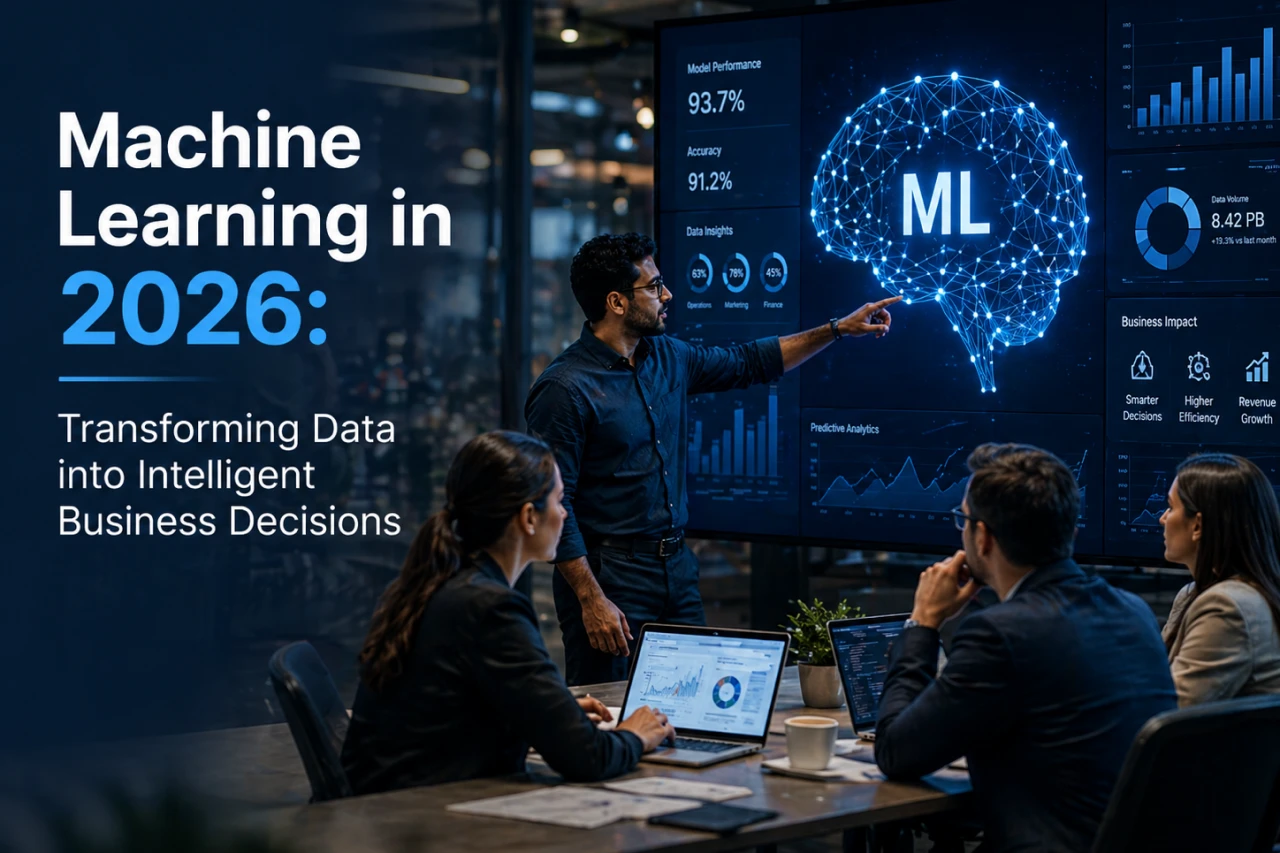
Introduction: The Power of Machine Learning
Machine Learning, a subset of Artificial Intelligence, is revolutionizing how organizations utilize data. By enabling systems to learn from data and improve over time, ML is transforming decision-making processes and operational efficiency.
In 2026, machine learning is at the core of data-driven innovation, empowering businesses to gain actionable insights and maintain competitive advantage.
Types of Machine Learning
Machine learning can be broadly categorized into:
- Supervised Learning: Uses labeled data for predictions
- Unsupervised Learning: Identifies patterns in unlabeled data
- Reinforcement Learning: Optimizes decisions through trial and error
Each type serves distinct purposes and is applied across various domains.
Data as the Foundation of ML
High-quality data is critical for effective machine learning models. Data preprocessing, cleaning, and transformation ensure accuracy and reliability.
Organizations must invest in data governance and infrastructure to maximize the value of ML initiatives.
Predictive Analytics and Forecasting
Machine learning enables predictive analytics, allowing businesses to forecast trends and behaviors. This enhances strategic planning and reduces uncertainty.
Applications include demand forecasting, risk assessment, and customer segmentation.
Personalization and Recommendation Systems
ML-powered recommendation systems deliver personalized experiences by analyzing user behavior and preferences. This improves engagement and drives revenue growth.
Platforms leverage these systems to provide relevant content, products, and services.
Automation and Robotics
Machine learning enhances automation by enabling systems to adapt and learn. Intelligent robots and automated processes are transforming industries such as manufacturing and logistics.
This leads to increased efficiency, reduced costs, and improved accuracy.
Fraud Detection and Risk Management
ML algorithms are highly effective in detecting anomalies and preventing fraud. Financial institutions use these models to identify suspicious activities and mitigate risks.
Continuous learning ensures adaptability to evolving threats.
Challenges in Machine Learning Implementation
Despite its advantages, ML presents challenges such as:
- Data bias and quality issues
- Model interpretability
- Scalability and infrastructure requirements
Addressing these challenges is essential for successful implementation.
Integration with Cloud and Big Data
Cloud computing provides the scalability required for ML applications. Integration with big data platforms enables processing of massive datasets.
This synergy enhances the performance and accessibility of machine learning solutions.
The Future of Machine Learning
Advancements in deep learning, neural networks, and AI integration will further expand the capabilities of ML. Autonomous systems, real-time analytics, and intelligent decision-making will define the future.
Conclusion
Machine learning is transforming data into actionable intelligence, enabling businesses to innovate and grow. Organizations that leverage ML effectively will gain a significant competitive edge. Techinvent Global Private Limited provides cutting-edge machine learning solutions to help businesses unlock their full potential.