Introduction
The manufacturing industry is rapidly evolving in 2026. Businesses that continue relying on disconnected software systems, spreadsheets, and manual workflows are struggling to maintain efficiency and scalability. Operational delays, inventory inaccuracies, and poor production coordination are no longer acceptable in a highly competitive industrial environment.
One mid-sized manufacturing company faced these exact challenges before partnering with Techinvent Global Private Limited. By implementing a custom AI-powered ERP ecosystem, the company achieved a remarkable 63% increase in operational efficiency while significantly reducing administrative complexity and inventory wastage.
This case study explores how intelligent digital transformation reshaped the entire manufacturing workflow.
The Hidden Cost of Manual Manufacturing Operations
Many manufacturing businesses unknowingly lose substantial revenue due to inefficient operational processes. Departments often work independently using separate tools, causing communication gaps and inconsistent reporting.
Common operational challenges include:
- Delayed procurement approvals
- Inventory mismatch issues
- Manual production tracking
- Human errors in reporting
- Slow payroll and attendance processing
- Lack of real-time visibility
These inefficiencies gradually increase operational expenses while reducing productivity and customer satisfaction.
Why Manufacturing Businesses Need Intelligent ERP Systems
As manufacturing companies grow, managing multiple operational processes manually becomes increasingly difficult. Modern ERP systems centralize business functions into a unified ecosystem, allowing companies to streamline workflows and improve decision-making.
AI-powered ERP solutions provide:
- Real-time operational monitoring
- Automated inventory forecasting
- Predictive production planning
- Smart financial reporting
- Employee performance tracking
- Vendor and procurement automation
The integration of artificial intelligence adds an additional layer of operational intelligence, enabling businesses to identify problems before they become critical.
The Client’s Operational Challenges Before Digital Transformation
The manufacturing client approached Techinvent Global Private Limited after experiencing persistent operational inefficiencies that affected profitability and delivery performance.
The company struggled with:
Inventory Discrepancies
Stock records frequently differed from actual warehouse inventory, leading to production interruptions.
Delayed Reporting
Manual reporting processes delayed business decision-making and created inaccuracies.
Poor Department Coordination
Procurement, production, finance, and inventory departments operated independently without centralized communication.
Inefficient Workforce Management
Attendance tracking and payroll processing consumed excessive administrative time.
Inaccurate Production Forecasting
The absence of predictive analytics caused frequent overproduction and raw material shortages.
How Techinvent Global Private Limited Designed the ERP Solution
After conducting a detailed operational analysis, Techinvent Global developed a fully customized ERP architecture tailored specifically to the manufacturing workflow.
The ERP system integrated:
- Procurement management
- Inventory tracking
- Production scheduling
- Financial management
- HR and payroll systems
- CRM and vendor management
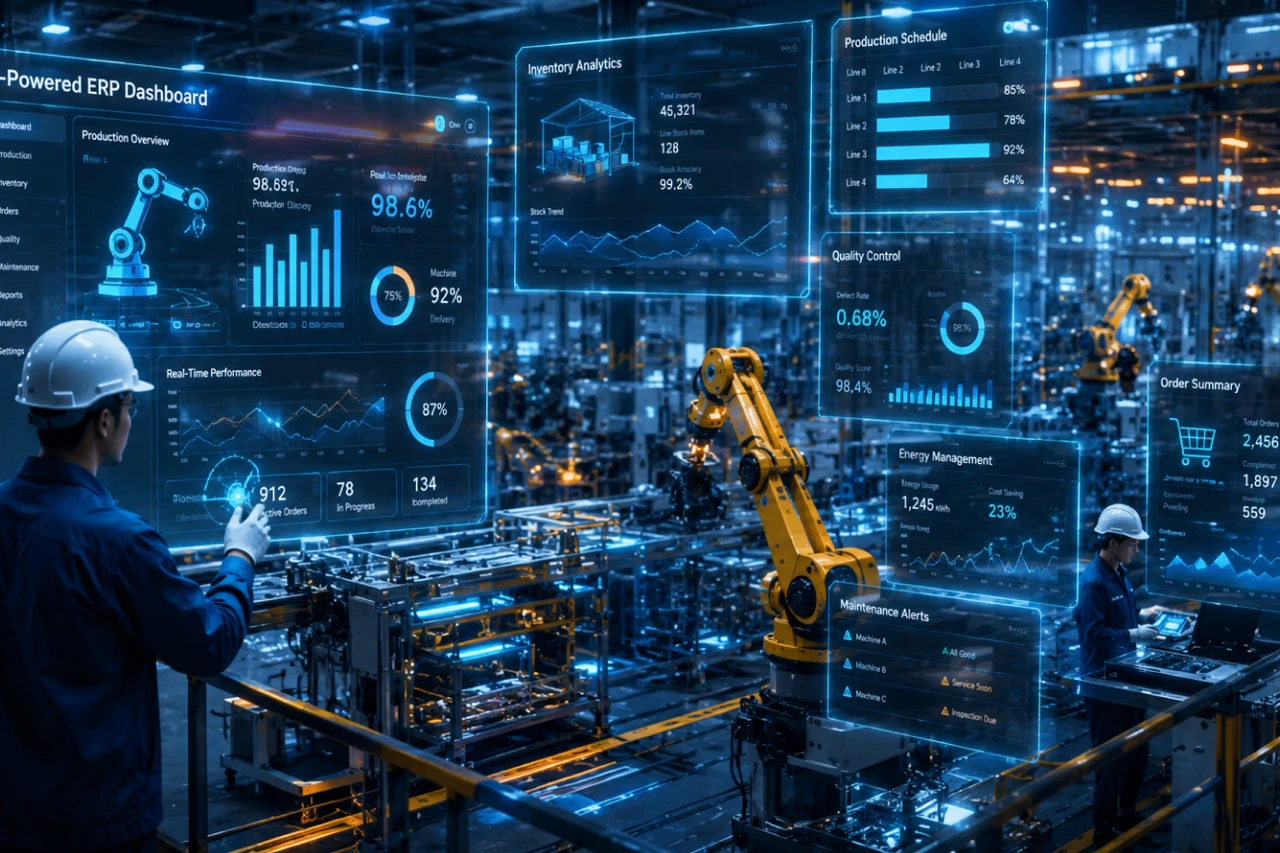
The centralized dashboard provided management with complete real-time visibility across departments.
AI Features That Revolutionized Manufacturing Operations
The implemented ERP ecosystem included several AI-driven capabilities designed to improve operational intelligence and automation.
Predictive Inventory Management
The system automatically analyzed historical inventory trends and predicted future stock requirements.
Automated Procurement Alerts
The ERP platform generated intelligent purchase alerts before inventory shortages occurred.
AI-Based Production Scheduling
Production planning became more efficient through predictive scheduling algorithms.
Smart Reporting Dashboards
Executives gained access to real-time analytics and visual business intelligence reports.
Employee Performance Analytics
The platform monitored productivity metrics and optimized workforce allocation.
Seamless ERP Deployment Without Business Downtime
One of the major concerns during ERP implementation is operational disruption. Techinvent Global addressed this by adopting a phased deployment strategy.
The implementation process included:
- Operational workflow analysis
- Secure data migration
- Department-wise system integration
- Employee onboarding and training
- Testing and optimization
This structured approach ensured uninterrupted manufacturing operations during deployment.
Results Achieved After ERP Implementation
Within six months of deployment, the manufacturing company experienced substantial improvements across operations.
Key Performance Improvements
- 63% increase in operational efficiency
- 42% reduction in inventory wastage
- 55% faster reporting processes
- 37% improvement in production accuracy
- Significant reduction in manual administrative work
The company also improved delivery timelines and customer satisfaction.
Why Custom ERP Solutions Outperform Generic Software
Many businesses initially choose generic ERP software because of lower upfront costs. However, off-the-shelf systems often fail to adapt to industry-specific operational requirements.
Custom ERP systems provide:
- Better scalability
- Industry-specific workflows
- Flexible feature integration
- Improved security architecture
- Higher long-term ROI
Techinvent Global focuses on building customized enterprise solutions that align with specific business objectives and operational structures.
The Future of Smart Manufacturing
Manufacturing is rapidly entering the era of Industry 4.0. AI, IoT, automation, and predictive analytics are transforming how factories operate worldwide.
Future-ready manufacturing businesses are investing in:
- Smart factory automation
- IoT-enabled machinery
- Predictive maintenance systems
- AI-powered quality control
- Real-time production analytics
Companies adopting intelligent technologies today will maintain stronger competitive advantages tomorrow.