
Dedicated Development Team Model: How to Add Engineering Capacity Without Adding Management Overhead
As product companies grow, engineering demand often moves faster than the team supporting it.
As product companies grow, engineering demand often moves faster than the team supporting it.
The roadmap expands. More customer requirements enter the backlog. New products, integrations, infrastructure work, and technical debt compete for the same engineering capacity. At the same time, senior engineers are already balancing feature delivery with architecture decisions, code reviews, production issues, mentoring, and release responsibilities.
Hiring more engineers seems like the obvious answer.
Sometimes it is.
But there is an important difference between increasing engineering headcount and increasing engineering capacity.
Adding developers gives you more people immediately. It creates meaningful capacity only when those developers can gradually understand the product, operate within the engineering system, make appropriate day-to-day decisions, and take responsibility for clearly defined areas of work.
If every requirement, blocker, and technical decision still depends on the same internal senior engineers, the organization may have more developers without actually removing the original bottleneck.
That is why the most useful question is not:
“How many developers can we add?”
It is:
“How much engineering ownership can we add without increasing management overhead at the same rate?”
That distinction should influence how companies evaluate dedicated development teams, how external engineers are onboarded, and what level of involvement should be expected from the provider behind them.
A dedicated development team works best when external engineers become integrated members of the engineering organization, build product and technical context, and gradually take ownership of defined workstreams. The model creates less value when those engineers remain dependent on the client for every task-level decision.
What Is a Dedicated Development Team Model?
A dedicated development team model gives a company access to one or more engineers who work closely with its existing product and engineering organization over an extended period.
Unlike traditional project outsourcing, where a vendor may take responsibility for delivering a defined project, dedicated engineers generally operate within the client’s existing delivery environment.
They may participate in:
- Daily standups
- Sprint planning
- Backlog refinement
- Technical discussions
- Code reviews
- Retrospectives
- Release planning
- Architecture discussions
They usually work with the same repositories, development environments, project-management tools, communication channels, coding standards, and delivery processes used by the internal team.
The client typically retains ownership of product priorities, architecture direction, engineering standards, business decisions, and roadmap priorities.
The dedicated engineers extend the client’s execution capacity. The concept appears simple, but the operating model behind it matters significantly.
Two companies can both advertise “dedicated engineers” while providing very different experiences.
One may provide developers who receive tasks, complete tickets, and depend heavily on the client for day-to-day direction.
Another may provide engineers who build context, participate in technical discussions, understand dependencies, communicate risks, and eventually take ownership of a module, service, integration, or workstream.
Both models add people.
Only one consistently distributes engineering responsibility.
Why Adding Developers Does Not Always Add Engineering Capacity
Hiring speed is one of the most common reasons companies consider dedicated engineers.
An upcoming release may need additional backend capacity. A product team may need frontend or mobile expertise. The business may need DevOps, QA automation, cloud, or data engineering skills that are not currently available internally.
Those are real capacity problems.
However, management capacity can become an equally important constraint.
Every engineer who joins a product team needs context. Someone has to explain the product, architecture, development environment, standards, priorities, and current technical decisions.
During the first weeks, that is expected.
The problem begins when the same level of direction continues indefinitely.
Consider an external engineer who has been working with the product for several months but still needs the internal tech lead to:
- Break every requirement into implementation-level tasks
- Explain recurring architecture decisions
- Resolve routine dependencies
- Review every implementation choice
- Decide what to work on next
- Follow up on progress continuously
The engineer may still be writing code and completing tickets.
However, the internal team has not transferred much responsibility.
The tech lead remains the control point for most decisions.
As more developers are added, the amount of coordination around that tech lead may increase.
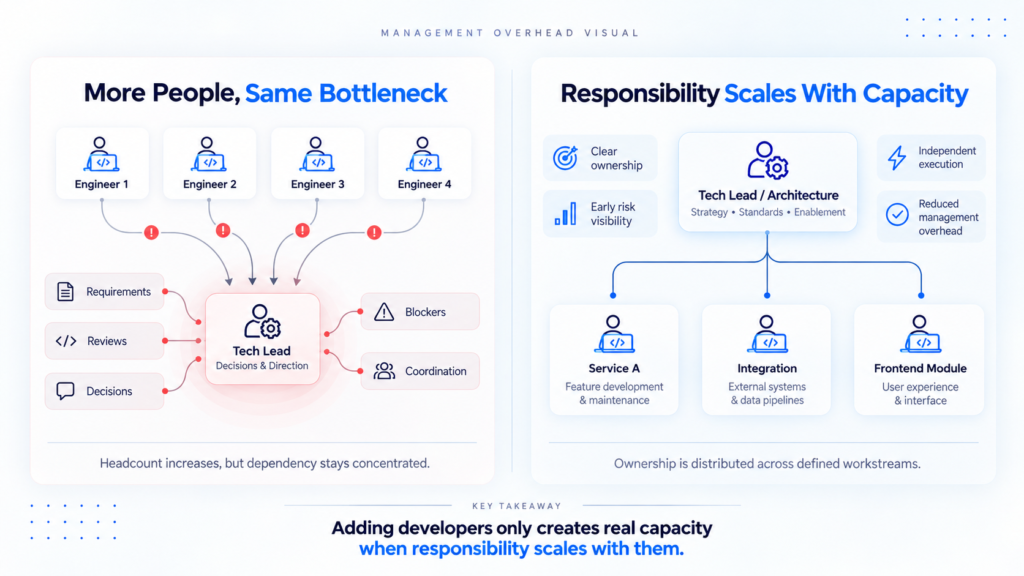
The team grows, but the bottleneck remains.
That is the difference between adding resources and adding capacity.
The Hidden Management Cost of Adding External Engineers
The direct cost of an external engineer is easy to understand.
The internal cost of making that engineer productive is less visible.
Suppose a senior engineer spends several hours each week explaining requirements, reviewing routine decisions, answering questions, resolving blockers, checking progress, and correcting misunderstandings.
That time does not appear on the provider invoice.
It still has a cost.
Every hour spent on unnecessary task-level coordination is an hour that senior engineers cannot spend on areas such as:
- Architecture
- Reliability
- Security
- Technical debt
- Platform engineering
- Performance
- Product development
- Engineering standards
- Mentoring
- Release planning
This is one reason a team can become larger without feeling meaningfully less constrained.
More engineers create more communication paths, more reviews, more onboarding needs, and more dependencies.
The issue becomes particularly visible when one or two experienced engineers remain the source of truth for nearly every technical decision.
If each additional developer creates more demand around those people, the organization is increasing headcount around a bottleneck rather than distributing responsibility away from it.
A strong dedicated engineering model should move in the opposite direction.
As context grows, dependency should reduce.
More Developers vs More Engineering Ownership
| Task-Based Resource | Ownership-Oriented Engineer |
|---|---|
| Waits for the next assigned ticket | Understands current priorities |
| Focuses only on assigned tasks | Owns a defined workstream |
| Escalates routine decisions | Makes appropriate day-to-day decisions |
| Needs requirements repeatedly explained | Builds product and domain context |
| Reports completed tasks | Communicates progress, risks, and dependencies |
| Waits for blockers to be resolved | Identifies and helps resolve blockers early |
| Depends heavily on an internal tech lead | Works with increasing independence |
| Understands the code being changed | Understands how the change affects the broader product |
Ownership does not mean handing complete product or architecture control to an external engineer.
The client may still own overall architecture, while the dedicated engineer owns implementation of a particular service.
The client may define product priorities, while the engineer takes responsibility for delivering a feature area.
The client may establish engineering standards, while the engineer applies those standards without requiring repeated supervision.
The objective is not complete independence.
It is appropriate independence.
An engineer should understand which decisions can be made independently, which require collaboration, and which belong to the client’s technical leadership.
When those boundaries are clear, ownership can increase without sacrificing control.From Context to Contribution to Ownership
A useful way to evaluate a dedicated engineering engagement is to look at how the engineer progresses over time.
At Techinvent Global, we believe that progression should generally move through three stages:
Context → Contribution → Ownership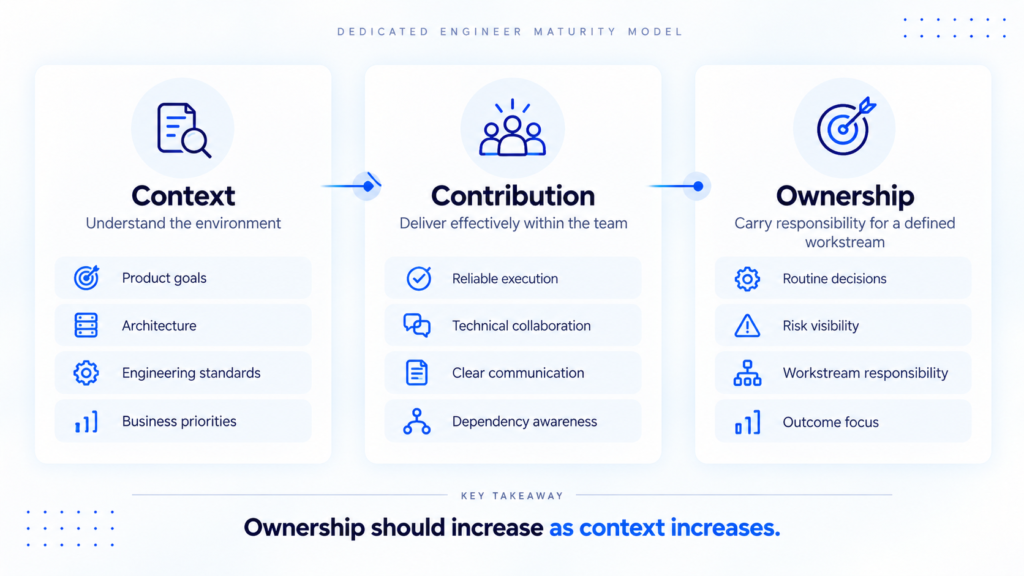
Context
Every engineer needs time to understand the environment they are joining.
That includes:
- Product goals
- Users
- Architecture
- Codebase
- Engineering standards
- Release process
- Team responsibilities
- Business priorities
The objective during this stage is not maximum independence.
The objective is to create enough understanding for meaningful contribution.
Contribution
Once the engineer understands the environment, they should contribute effectively within the existing engineering process.
They should be able to:
- Complete work reliably
- Participate in technical discussions
- Follow established standards
- Communicate blockers clearly
- Understand dependencies
- Collaborate with internal engineers
- Contribute to reviews and planning
At this stage, the engineer is useful, but significant ownership may still sit with internal leadership.
Ownership
As product and architecture knowledge grows, the engineer should begin taking responsibility for a clearly defined area.
That could be:
- A backend service
- A frontend module
- An integration
- A QA automation workstream
- A DevOps initiative
- A feature area
- A maintenance stream
Ownership means the engineer no longer needs detailed task-by-task direction for routine execution.
They understand the desired outcome, know the relevant engineering constraints, make appropriate implementation decisions, raise risks early, and know when a larger decision needs escalation.
This progression provides a much stronger measure of engagement quality than utilization alone.
If an engineer has been working with a product for twelve months but still requires the same level of supervision as in the first month, the engagement may have stopped at task execution.
How Dedicated Engineers Should Integrate With Your Engineering Team
One common mistake is treating external engineers as a separate delivery channel.
The internal team works in one system.
The external engineers work in another.
Requirements move between the two groups. Questions move back. Completed work returns for review.
Every handoff creates additional coordination.
A stronger model integrates dedicated engineers directly into the engineering system that already exists.
That generally means working within the same:
- Sprint cadence
- Backlog
- Communication channels
- Development environments
- Engineering standards
- Documentation
- Code review process
- Testing processes
- Release workflow
- Quality expectations
This integration matters because good engineering decisions depend on context.
A developer who sees only a ticket knows what has been requested.
An engineer who understands the product, architecture, dependencies, customer impact, and release priorities understands why the work matters and how it fits into the larger system.
That context improves decision-making.
It also becomes more valuable over time.
An engineer who remains with a product begins to understand historical decisions, recurring patterns, dependencies between systems, release constraints, and areas of technical risk.
That accumulated knowledge is one of the main advantages of continuity in a dedicated model.
The value of a dedicated engineer is not only the development hours they provide.
It is also the context they retain.
Why Time-Zone Overlap Matters for Dedicated Engineering Teams
Remote engineering discussions often focus heavily on location.
For delivery, working-hour overlap is often the more important consideration.
Can the dedicated engineer participate in sprint planning?
Can they resolve a technical question while the internal team is available?
Can they discuss a production issue with the relevant engineer in real time?
Can product questions be answered before another development day is lost?
When teams have very little overlap, small dependencies can create unnecessary delay.
An engineer may encounter a blocker halfway through the day and wait until the following day for a response. A short technical conversation can turn into several asynchronous exchanges.
Meaningful overlap reduces that friction.
It supports:
- Real-time technical discussions
- Sprint ceremonies
- Pairing
- Faster blocker resolution
- Code-review conversations
- Better collaboration
- Stronger team integration
The goal does not have to be identical working hours.
The goal should be enough shared time for external engineers to participate meaningfully in the client’s delivery rhythm.
The Provider Should Not Disappear After the Engineer Joins
This is one of the most important differences between dedicated engineering models.
A common model works like this:
The provider recruits the developer.
The developer joins the client.
The client manages everything related to delivery.
The provider remains involved mainly for contracts, payroll, administration, or replacement.
That approach can work for organizations with significant internal engineering-management capacity.
However, it also means the client inherits most of the responsibility around execution.
If the engineer faces a technical challenge, the client manages it.
If expectations become unclear, the client resolves them.
If performance concerns appear, the client handles them.
If the engineer needs additional technical support, the client provides it.
If continuity becomes a problem, the client carries much of the impact.
That creates an important question when selecting a dedicated engineering provider:
What support exists behind the engineer after placement?
A provider should be able to answer that clearly.
At Techinvent Global, our view is that dedicated engineers should work directly with the client’s team while still having technical and delivery support behind the engagement.
The objective is not to create a communication layer between the client and engineer.
It is to make sure that the client is not the only source of support when difficult execution issues arise.
The Techinvent Global Three-Layer Dedicated Engineering Model
The model we believe works well has three connected layers.
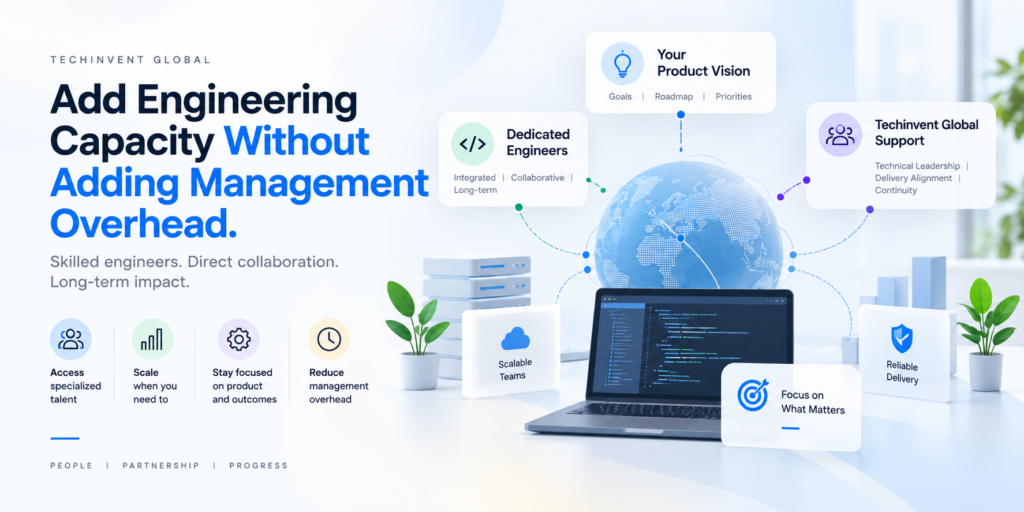
1. Client Engineering Team
The client retains ownership of the areas where internal business and technical context matter most.
These generally include:
- Product priorities
- Business decisions
- Architecture direction
- Roadmap priorities
- Engineering standards
- Final technical authority
Dedicated engineers extend the engineering organization.
They do not replace the company’s product or technical leadership.
2. Dedicated Engineer
The dedicated engineer works directly within the client’s delivery environment.
Depending on the engagement, that engineer may take responsibility for a feature area, backend service, frontend module, integration, testing stream, DevOps workstream, or another defined area.
The expectation is that responsibility increases as context increases.
Early in the engagement, more guidance is expected.
Over time, routine execution decisions should require less supervision.
3. Techinvent Global Technical and Delivery Leadership
Behind the engineer, Techinvent Global’s technical and delivery team remains aligned with the engagement.
That support can include:
- Requirement understanding
- Execution alignment
- Technical challenges
- Delivery risks
- Performance concerns
- Escalations
- Knowledge continuity
- Resource transitions
Techinvent Global’s technical and delivery leadership brings more than 20 years of industry experience behind this layer.
The purpose is not to interfere with direct collaboration between the client and engineer.
The purpose is to provide an additional technical and delivery support structure when the engagement needs it.
A practical responsibility model can look like this:
| Responsibility | Client | Dedicated Engineer | Techinvent |
|---|---|---|---|
| Product priorities | Owns | Understands | Remains aligned |
| Architecture direction | Owns | Contributes | Supports where required |
| Day-to-day implementation | Provides context | Owns | Supports |
| Workstream execution | Defines desired outcome | Owns | Helps monitor and support |
| Technical blockers | Escalation point for major decisions | Resolves appropriate issues | Provides additional support |
| Delivery risks | Reviews | Identifies early | Helps manage |
| Performance feedback | Provides input | Accountable for contribution | Supports and manages |
| Knowledge continuity | Participates | Maintains documentation and handover | Supports continuity |
| Resource transition | Consulted | Supports handover | Coordinates |
This creates a model where the client keeps control, the engineer gets direct ownership, and Techinvent remains accountable for supporting the engagement.
What a Good Dedicated Engineering Engagement Looks Like in Practice
Consider a SaaS company with an established engineering team.
Its roadmap has expanded. Two backend initiatives now need to move in parallel, while the same senior engineers are responsible for architecture, reviews, production issues, and mentoring.
Permanent hiring may remain part of the long-term strategy, but additional capacity is required sooner.
The company adds two dedicated backend engineers.
The engagement can develop in two very different ways.
Scenario 1: More People, Same Bottleneck
The new engineers receive tickets from the backlog.
The internal tech lead explains each requirement and remains responsible for most technical decisions.
When an architecture question appears, work pauses.
When a dependency becomes unclear, the engineers escalate it.
The internal team reviews most implementation decisions in detail because the dedicated engineers have limited context outside their assigned tasks.
The engineers are still productive. Code is written and tickets are completed.
However, the original dependency has not changed.
The tech lead remains involved in almost every meaningful decision.
The organization has added two developers, but it has not added the same amount of independent engineering capacity.
Scenario 2: Increasing Workstream Ownership
Now consider a different operating model.
The engineers participate in sprint planning and technical discussions.
They learn the relevant architecture and understand the business context behind their work.
Clear responsibility boundaries are established.
One engineer begins owning a specific backend service. The other takes responsibility for a defined integration workstream.
They still involve the internal tech lead when architecture-level decisions or significant trade-offs arise.
However, routine implementation choices no longer require constant escalation.
They communicate risks earlier, identify dependencies before they become blockers, and understand how their work affects upcoming releases.
Techinvent Global’s technical and delivery leadership remains aligned behind the engagement when additional support is needed.
There is no need to invent a percentage improvement to understand the difference.
In the second model, responsibility has begun moving with the work.
That is a much stronger indicator of engineering capacity.
When Should You Hire Dedicated Engineers?
A dedicated engineering model can work well when a company already has product and technical direction but needs more execution capacity.
Several situations make the model particularly relevant.
Your Roadmap Is Larger Than Your Current Team Can Deliver
You already know what needs to be built, but your current team cannot move every priority forward without delaying other work.
Dedicated engineers can add execution capacity without requiring the same long-term commitment as immediate permanent expansion.
Permanent Hiring Cannot Solve the Capacity Problem Quickly Enough
Permanent hiring may remain the preferred strategy for core long-term roles.
However, recruitment operates on a different timeline from product delivery.
Dedicated engineers can provide additional capacity while hiring continues.
The Need Is Likely to Continue for Several Months
The model becomes more valuable when engineers have enough time to build product and architecture knowledge.
Continuity allows responsibility to increase.
Product Requirements Will Continue to Evolve
Product development rarely follows a completely fixed specification.
If priorities are likely to change, direct integration with the product and engineering team gives dedicated engineers the context needed to adapt.
You Want to Retain Technical Control
Some organizations need more engineers but do not want to outsource an entire product or platform.
A dedicated model allows the client to retain architecture, roadmap, and engineering-process control while extending execution capacity.
You Need Specific Engineering Capability
A product organization may need backend, frontend, cloud, DevOps, QA automation, mobile, data, or another technical capability without immediately building an entire permanent team around it.
A dedicated model can provide that capacity while the need develops.
When Is a Dedicated Development Team Not the Right Model?
Dedicated engineering is not the right answer for every delivery problem.
You Only Need a Small Fixed Deliverable
A short project with stable requirements and a clearly defined outcome may be better suited to project-based delivery.
Nobody Internally Owns the Product
External engineers can execute product decisions.
They cannot replace clarity about what should be built, which users matter, which trade-offs should be made, or what the business is trying to achieve.
Your Engineering Environment Is Not Ready for Onboarding
If access is difficult, environments are unstable, requirements are unclear, documentation is missing, and engineering processes are inconsistent, adding people can initially increase pressure.
Some delivery structure still needs to exist.
You Need Consulting Rather Than Additional Capacity
Sometimes the real problem is architecture, modernization, cloud strategy, engineering process, security, or product direction.
In those cases, advisory or project expertise may be more valuable than additional engineers.
Your Only Selection Criterion Is Hourly Rate
The lowest hourly rate does not necessarily produce the lowest engineering cost.
A lower-cost resource who requires significant internal supervision may consume more senior-engineering time than a stronger engineer who can operate with greater independence.
Dedicated Team vs Staff Augmentation vs In-House Hiring vs Project Outsourcing
These models solve different problems.
| Model | Best Fit | Client Control | Typical Duration | Provider Involvement |
|---|---|---|---|---|
| Permanent Hiring | Core long-term capability | High | Long term | None |
| Traditional Staff Augmentation | Additional temporary capacity | High | Short to medium term | Often limited after placement |
| Dedicated Engineering Team | Integrated ongoing engineering capacity | High | Medium to long term | Depends on provider model |
| Project Outsourcing | Defined project or outcome | Lower day-to-day control | Project based | High |
The terminology varies across providers, so the label alone does not tell you how the engagement will operate.
A provider may describe its service as a dedicated development team while functioning primarily as a recruitment and placement company.
Another provider may remain involved in technical support, delivery alignment, performance, and continuity.
The operating model matters more than the label.
The Real Cost of a Dedicated Engineering Model
Dedicated engineering decisions are often reduced to hourly or monthly rates.
That comparison is incomplete.
The real cost of a dedicated resource includes more than the vendor invoice.
A more realistic way to think about total cost is:
External engineering cost
- onboarding effort
- internal management time
- technical supervision
- coordination overhead
- replacement risk
- knowledge-transfer cost
A provider with a lower hourly rate may appear less expensive.
However, if the engineers require significant internal support, the company may end up using high-cost senior engineering capacity to compensate.
This is why the question should not only be:
“What does this developer cost?”
It should also be:
“What internal effort will be required to make this developer effective?”
A well-integrated engineer who gradually takes ownership may create more value than a lower-cost engineer who requires permanent task-level supervision.
Questions CTOs Should Ask a Dedicated Engineering Provider
A useful way to evaluate providers is to focus less on recruitment claims and more on what happens after the engineer starts.
When evaluating a technology delivery partner, it is also worth looking beyond resource availability and hourly rates to delivery capability, governance, technical support, and long-term alignment.
Will the Engineer Work Directly With Our Team?
Understand whether the engineer will collaborate directly with developers, technical leads, product managers, and stakeholders or communicate primarily through vendor-side coordinators.
Will the Engineer Participate in Our Engineering Ceremonies?
If you want genuine integration, engineers should be able to participate in the planning, reviews, retrospectives, and technical discussions that shape the work.
How Much Working-Hour Overlap Will We Have?
Ask about practical collaboration time rather than geography alone.
Who Supports the Engineer When Technical Challenges Arise?
If the answer is always your internal tech lead, much of the technical support burden remains with your organization.
What Happens After Onboarding?
Many providers describe recruitment and onboarding in detail.
Ask how they stay involved three, six, or twelve months into the engagement.
How Is Performance Managed?
There should be a clear process for addressing concerns around communication, technical quality, contribution, and ownership.
What Happens If an Engineer Leaves?
Understand how replacement, documentation, handover, and knowledge transfer are handled.
Can the Engineer Eventually Own a Defined Workstream?
If the engagement is permanently task-based, it may never reduce internal management overhead significantly.
How Flexible Is the Team Structure?
Engineering needs change.
Understand how the team can scale, change skill composition, or transition responsibilities.
Who Owns Delivery Escalation?
When a serious issue appears, the escalation path should be clear.
The client should not automatically become responsible for every difficult execution problem.
Red Flags When Evaluating Dedicated Engineering Providers
Several signals can indicate that a dedicated resource model may create more management burden than expected.
Watch for providers that:
- Focus heavily on CVs but struggle to explain the operating model
- Disappear after the engineer is placed
- Provide no technical escalation path
- Measure performance mainly by hours worked
- Cannot explain how delivery concerns are handled
- Offer very little working-hour overlap
- Keep engineers isolated from client planning and technical discussions
- Have no clear continuity or knowledge-transfer process
- Cannot explain what happens when a resource underperforms
- Expect the client’s tech lead to solve every technical issue
A provider should be able to explain not only how engineers are hired, but how the engagement is supported after those engineers become part of the team.
How to Measure Whether Your Dedicated Engineering Model Is Working
Hours worked, utilization, tickets completed, and sprint velocity can provide useful information.
They should not be the only measures.
The broader question is whether the engagement improves the engineering organization.
Ask:
- Is the engineer building meaningful product knowledge?
- Is architecture context increasing?
- Can the engineer own a defined area of delivery?
- Are risks being identified earlier?
- Are routine technical decisions requiring less escalation?
- Is task-level supervision reducing over time?
- Are senior engineers spending less time on repetitive coordination?
- Is knowledge becoming distributed across more people?
- Can the engineer participate meaningfully in technical discussions?
- Does the internal team trust the engineer with increasingly important work?
One of the strongest indicators is whether responsibility increases as context increases.
If an engineer works with the product for a year but requires the same level of supervision as during the first month, the engagement may have reached a ceiling.
If context, autonomy, and ownership continue to grow, the organization is much closer to adding genuine engineering capacity.
The Real Decision: Headcount or Engineering Capacity?
Engineering organizations do not scale simply because they employ more developers.
They scale when knowledge, responsibility, and decision-making can be distributed without losing quality, alignment, or control.
That is why a conversation about dedicated engineers should not start with:
“How many developers can you provide?”
It should start with questions such as:
“What responsibilities do we need additional engineers to carry?”
“How will they become part of our engineering system?”
“How much management overhead will they create?”
“What technical support exists behind them?”
“Can these engineers eventually own meaningful workstreams rather than only execute tickets?”
At Techinvent Global, our dedicated engineering model is built around that distinction.
Dedicated engineers work directly with the client’s team, participate in existing engineering processes, maintain meaningful collaboration overlap, and build the context required to take greater ownership over time.
Behind those engineers, Techinvent’s technical and delivery leadership remains aligned with the engagement to support requirements, execution, technical challenges, delivery risks, performance, and continuity.
The client retains direct control over product and technical direction.
The dedicated engineer becomes part of the working engineering team.
Techinvent provides an additional technical and delivery support layer behind the engagement.
A well-structured dedicated engineering model should provide all three.
If you are evaluating dedicated engineers, start with three questions:
- Do we need more developers, or do we need more engineering ownership?
- Can the engineers we add eventually carry responsibility for a clearly defined workstream?
- Will the provider remain involved when difficult delivery and technical issues appear?
The answers will tell you far more about the likely success of the engagement than the number of CVs a provider can send.